
Nudibranch
These small, soft-bodied sea slugs are often brightly coloured.
Nudibranchs are molluscs that lose their shell after the larval stage. There are more than 3,000 species worldwide, and more than 400 occur in south-eastern Australia. 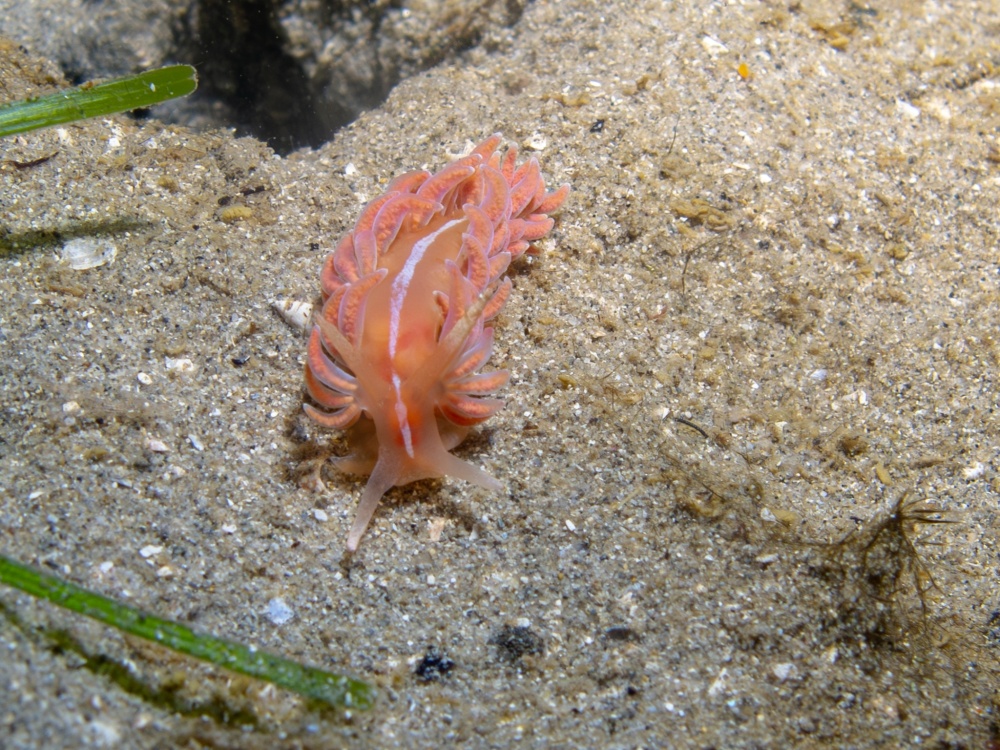
Nudibranch. Photo by Merv Dannefaerd, courtsey of the Great Southern Reef Foundation
Nudibranch
Sea slug
Nudibranchia
Many families, including Chromodorididae, Polyceridae, Dorididae and Flabellinidae
Nudibranch is a type of sea slug that comes in many colours and patterns, with feathery gills or finger-like projections on their backs.
From a few mm to 30cm or more.
Soft body with no shell and two sensory “horns” (rhinophores) on their head. Often brightly coloured, with spots, stripes or edging.
Their bright colours warn predators that nudibranchs are toxic or distasteful.
Salty water world wide, from the Arctic to the Antarctic in any temperature.
A wide variety of slow moving sea animals, such as sponges, hydroids, bryozoans, sea squirts, anemones or other sea slugs.
Nudibranchs hold both female and male reproductive organs.
All oceans, from polar to tropical waters. Diversity is highest in the tropical Indo-Pacific.
They face many ecological threats. Three of them are climate change and marine heatwaves, acidification of the ocean and pollution.
Frequently asked questions about the Nudibranch
What does the Nudibranch eat?
A wide variety of slow moving sea animals, such as sponges, hydroids, bryozoans, sea squirts, anemones or other sea slugs.
Where can I see the Nudibranch in Tasmania?
All oceans, from polar to tropical waters. Diversity is highest in the tropical Indo-Pacific.
Is the Nudibranch endangered?
What does the Nudibranch look like?
Soft body with no shell and two sensory “horns” (rhinophores) on their head. Often brightly coloured, with spots, stripes or edging.
Where does the Nudibranch live?
Salty water world wide, from the Arctic to the Antarctic in any temperature.
What threats does the Nudibranch face?
They face many ecological threats. Three of them are climate change and marine heatwaves, acidification of the ocean and pollution.
How does the Nudibranch breed and reproduce?
Nudibranchs hold both female and male reproductive organs.
You might like...
Big-bellied Seahorse
The big-bellied seahorse (Hippocampus abdominalis) is one of three seahorse species found in Tasmanian waters. Reaching up to 35 cm in height, they are one of the worlds largest seahorses, with a big round belly as their distinctive feature.
Tasmanian giant freshwater crayfish (Astacopsis gouldi)
The Tasmanian giant freshwater crayfish is the largest freshwater invertebrate in the world. Photo: Tilde Bergstrom
Little Penguin
This little penguin, also known as the fairy penguin, weigh just under one kilogram. Adorably awkward on land, but a skilled predator in the sea, this cute little creature can be found in New Zealand and the southern coast of Australia. Image: Dr Eric Woehler
Hooded Plover
The hooded plover is a small shorebird endemic to southern and eastern Australia that lives and nests on ocean beaches. Picture: Kim Murray
Newsletter
Sign up to keep in touch with articles, updates, events or news from Kuno, your platform for nature