
Little Penguin
This little penguin, also known as the fairy penguin, weigh just under one kilogram. Adorably awkward on land, but a skilled predator in the sea, this cute little creature can be found in New Zealand and the southern coast of Australia.

Little Penguins
Fairy penguin
Eudyptula minor
Penguins
These incredible little penguins (the smallest penguin in the world) have blue greyish or black feathers, with a silvery white colouring on their tummy and legs. Their wings have a white lining but most of their wings are dark blue and grey.
330-400mm
Their small body, black nails, the white lining on their wings and the black/blue body.
They swim low in the waters with small groups or on their own. They're incredibly skilled at diving and swimming underwater. They leave land at dawn to forage at sea during the day, and then they return to land at dusk under the cover of darkness.
Seas, islands and coasts.
Small fish, krill, anchovies, pilchards and garfish.
They usually breed in nests in burrows or under rocks, sometimes under buildings. They breed in vast colonies. They lay two eggs per clutch.
They live in New Zealand and southern Australia. Their are plentiful in Bass Strait and around Tasmania.
Protected
Attacks from dogs, foxes and cats. Human development and ocean pollution, fishing nets, fishing lines and plastic.
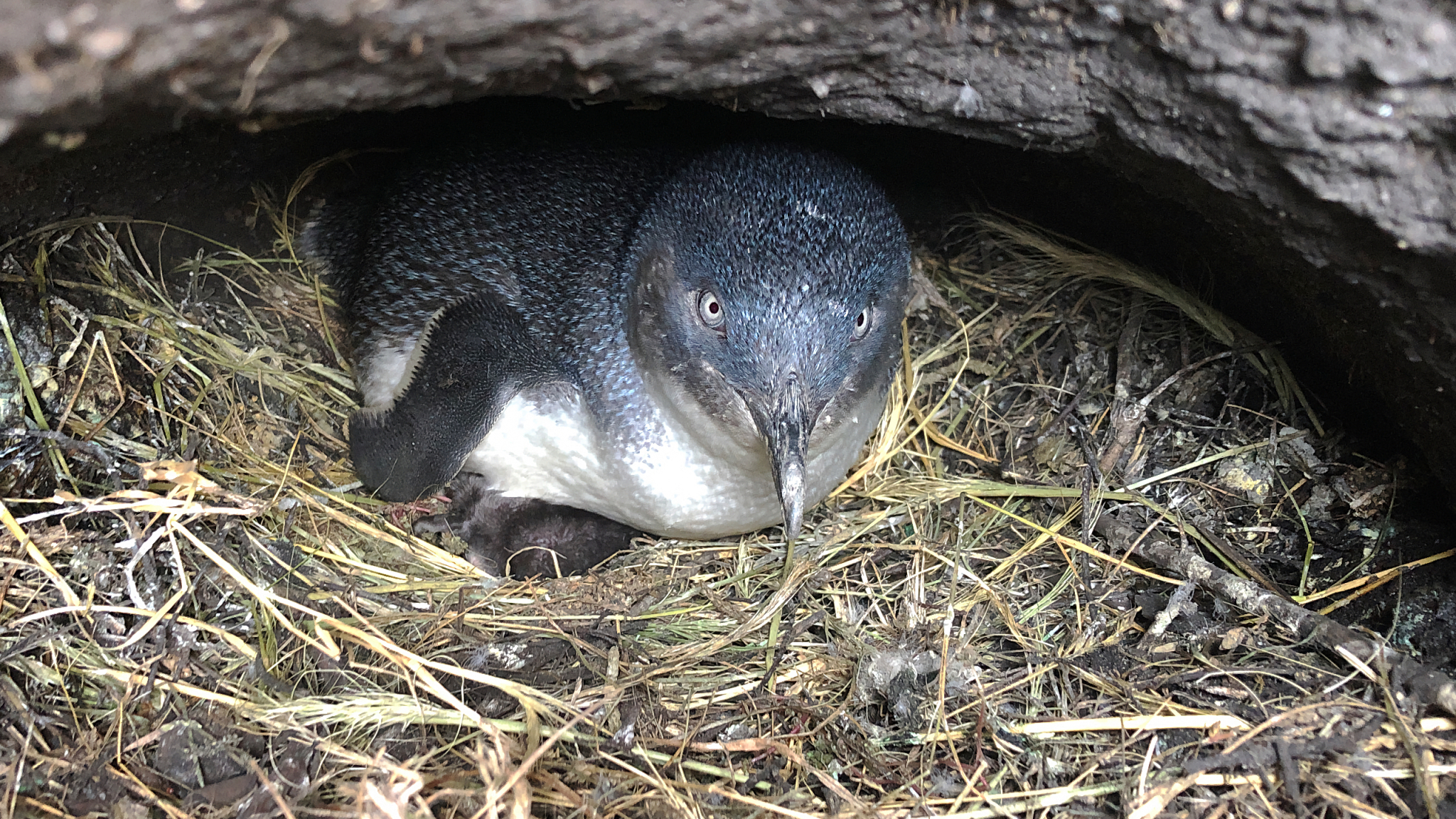
Little penguin in a burrow. By Dr Eric Woehler
A sharp yap. During matting, they utter loud braying, wheezing or browsing.
In Tasmania, you can find them in the Bicheno area on the east coast, around Marion Bay, the neck on Bruny Island or the north coast of Tasmania.
Frequently asked questions about the Little Penguin
What does the Little Penguin eat?
Small fish, krill, anchovies, pilchards and garfish.
Where can I see the Little Penguin in Tasmania?
In Tasmania, you can find them in the Bicheno area on the east coast, around Marion Bay, the neck on Bruny Island or the north coast of Tasmania.
Is the Little Penguin endangered?
Protected
What does the Little Penguin look like?
Their small body, black nails, the white lining on their wings and the black/blue body.
Where does the Little Penguin live?
Seas, islands and coasts.
What threats does the Little Penguin face?
Attacks from dogs, foxes and cats. Human development and ocean pollution, fishing nets, fishing lines and plastic. Little penguin in a burrow. By Dr Eric Woehler
How does the Little Penguin breed and reproduce?
They usually breed in nests in burrows or under rocks, sometimes under buildings. They breed in vast colonies. They lay two eggs per clutch.
You might like...

Little penguin paradise
Swift Parrot
The critically endangered Swift Parrot is a species of broad-tailed parrot only found in south-eastern Australia. Image: Rob Blakers
Powerful Owl
The Powerful Owl is the largest of Australia's owls, frequenting the moist forests of Australia's east. A large owl with a small head, brown and white barred colouring, and distinctive yellow eyes.
Pied Oystercatcher
The Pied Oystercatcher is a large wading shore-bird with a black face, back and chest, a white belly, white tail with black band at its end and a white wing-bar visible when flying. Its beak is a bright orange.
Newsletter
Sign up to keep in touch with articles, updates, events or news from Kuno, your platform for nature