
Tiger Plain Reflection: Coast to Cradle Wild Country
Coast to Cradle Wild Country
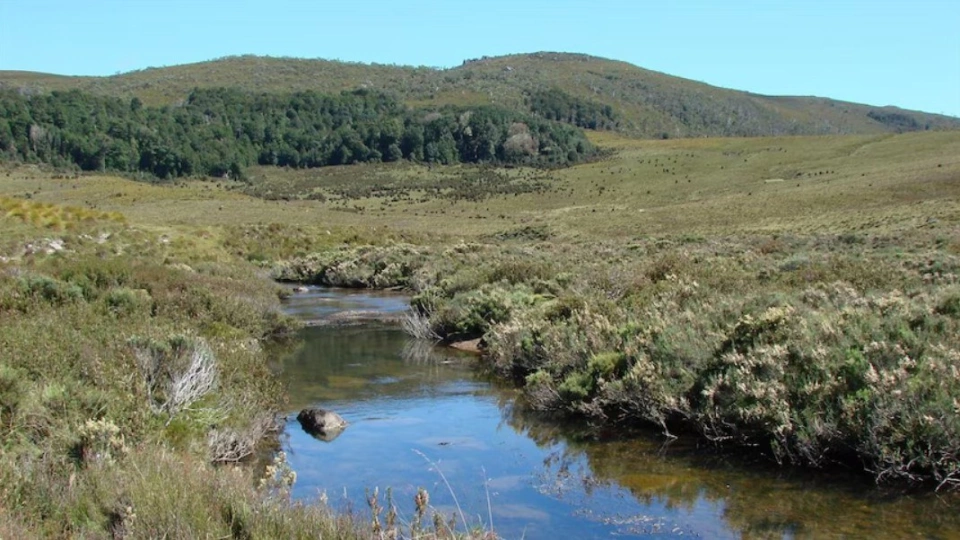
Tiger Plain is located within the Coast to Cradle Wild Country on the northeastern edge of the Black Bluff Nature Recreation Area. Tiger Plain is an evocative place connected to past encounters with the Tasmanian Tiger (Thylacinus cynosephalus).
In the 1860’s the mineral prospector James ‘Philosopher’ Smith regarded Tiger Plain as the most “tiger-infested” place he'd visited in Tasmania, and is where he once killed a female and found four pouch young. The last confirmed Thylacine died on 7 September 1936 in Hobart’s Beaumaris Zoo due, in large part, to neglect. Two months later the species was granted formal protection, but no replacement zoo exhibit was found.
The Black Bluff Range region is rich in Thylacine history.
Before the range was crossed by the Cradle Mountain Road, the area was visited by trappers, surveyors and bush workers, who passed down their stories.
The valley east of the range, known as the Vale of Belvoir, was once used as a summer dairy, with cows grazing on native grasslands and cheese made on site. The discarded milk whey was known to attract local Thylacines, at times seen drinking from a trough where the whey was poured.

Well after 1936, however, the area remained a place of potential Thylacine activity. The late Professor Jamie Kirkpatrick undertook a botanical feld trip in the open country west of the Black Bluff Range before the range was crossed by the Cradle Mountain Road, where he heard an animal call that he’d not previously experienced and, in the retelling of this story, Jamie entertained the possibility of hearing a Thylacine.
Professor Barry Brooks (University of Tasmania) led research that suggests that extinction was likely between 1940 to 1970’s but could have occurred as recently as the 1980’s to the early 2000’s and even a very slim chance the species persists.
Scientist John Gould prophesised as early as 1863 that with human encroachment upon Tasmania’s wild places ‘with …it’s primitive forests intersected with roads…’, the Thylacine would become extinct through hunting and other pressures.

The story of the Thylacine raises important questions about the relationships we share with other species and places like the Coast to Cradle Wild Country.
The Black Bluff Nature Recreation Area, including Tiger Plain, was gazetted as a reserve in 2000, but no management plan exists.
In 2003 the community-led ‘Canyon to Bluff Working Group’ obtained local support for the western side of Black Bluff and the areas around the Tiger Plain to become extensions to the Black Bluff Nature Recreation Area. This nomination was supported by the Tasmanian Forest Agreement 2012, and the forestry industry were compensated for the area’s protection, but gazetting to formalise this reserve still needs to occur.
It’s now time to discuss the appropriate nature reserve tenure for this special place, the species that live here, its history, and a management vision for its future.
Complete the Community Survey here: https://kuno.earth/articles/community-survey-coast-to-cradle

Kuno
Tiger Plain is located within the Coast to Cradle Wild Country on the northeastern edge of the Black Bluff Nature Recreation Area. Tiger Plain is an evocative place connected to past encounters with the Tasmanian Tiger (Thylacinus cynosephalus).
In the 1860’s the mineral prospector James ‘Philosopher’ Smith regarded Tiger Plain as the most “tiger-infested” place he'd visited in Tasmania, and is where he once killed a female and found four pouch young. The last confirmed Thylacine died on 7 September 1936 in Hobart’s Beaumaris Zoo due, in large part, to neglect. Two months later the species was granted formal protection, but no replacement zoo exhibit was found.
The Black Bluff Range region is rich in Thylacine history.
Before the range was crossed by the Cradle Mountain Road, the area was visited by trappers, surveyors and bush workers, who passed down their stories.
The valley east of the range, known as the Vale of Belvoir, was once used as a summer dairy, with cows grazing on native grasslands and cheese made on site. The discarded milk whey was known to attract local Thylacines, at times seen drinking from a trough where the whey was poured.
Well after 1936, however, the area remained a place of potential Thylacine activity. The late Professor Jamie Kirkpatrick undertook a botanical feld trip in the open country west of the Black Bluff Range before the range was crossed by the Cradle Mountain Road, where he heard an animal call that he’d not previously experienced and, in the retelling of this story, Jamie entertained the possibility of hearing a Thylacine.
Professor Barry Brooks (University of Tasmania) led research that suggests that extinction was likely between 1940 to 1970’s but could have occurred as recently as the 1980’s to the early 2000’s and even a very slim chance the species persists.
Scientist John Gould prophesised as early as 1863 that with human encroachment upon Tasmania’s wild places ‘with …it’s primitive forests intersected with roads…’, the Thylacine would become extinct through hunting and other pressures.
The story of the Thylacine raises important questions about the relationships we share with other species and places like the Coast to Cradle Wild Country.
The Black Bluff Nature Recreation Area, including Tiger Plain, was gazetted as a reserve in 2000, but no management plan exists.
In 2003 the community-led ‘Canyon to Bluff Working Group’ obtained local support for the western side of Black Bluff and the areas around the Tiger Plain to become extensions to the Black Bluff Nature Recreation Area. This nomination was supported by the Tasmanian Forest Agreement 2012, and the forestry industry were compensated for the area’s protection, but gazetting to formalise this reserve still needs to occur.
It’s now time to discuss the appropriate nature reserve tenure for this special place, the species that live here, its history, and a management vision for its future.
Complete the Community Survey here: https://kuno.earth/articles/community-survey-coast-to-cradle
Love what you're reading? Support Kuno donate to support them now
Donate hereYou might like...
The Vale of Belvoir: Rare grasslands in the Tasmanian Highlands
Coast to Cradle Wild Country vision survey opens to public
Coast to Cradle Wild Country Map
Coast to Cradle Wild Country: Community Survey
Newsletter
Sign up to keep in touch with articles, updates, events or news from Kuno, your platform for nature