
Weedy Seadragon
The weedy seadragon is a slender fish related to the seahorse, with small leaf-like appendages that camouflage it among kelp and seagrass. It is endemic to the Great Southern Reef, and it's the marine emblem of Victoria.
Weedy Seadragon
Common Seadragon
Phyllopteryx taeniolatus
Syngnathidae
A long, thin body with a red bodice, blue/violet bars and leaf-like appendages that camoflauges the Seadragon among kelp and seagrass.
Can reach up to 45 cm in length
Their long, tube-like snout and the coloured lines across the body.
The weedy seadragon lack teeth and a true stomach, and instead feed by vacuuming up small prey with their snout.
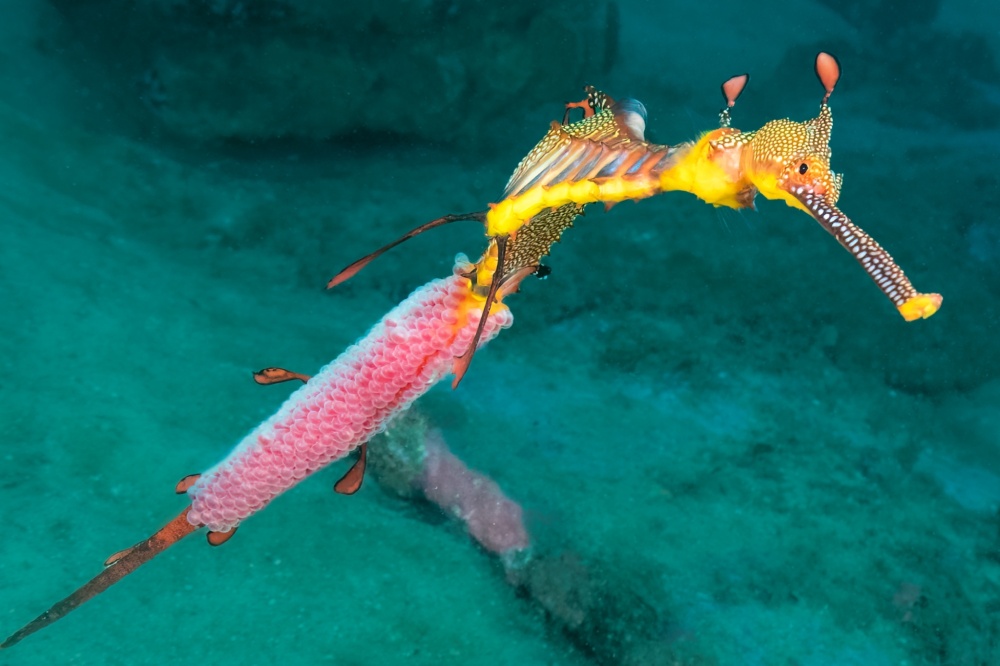
Photo by Mike Jones, courtesy of the Great Southern Reef Foundation. The male Weedy Seadragon carries the eggs on his tale until they hatch.
Temperate coastal waters and rocky reefs.
Zooplankton, small crustasceans and mysid shrimp.
They are solitary creatures for most of the year, but they converge during spring to pair up and breed. The female lays roughly 120–300 eggs onto the male's tail. He carries them for around 4–8 weeks, depending on water temperature, and the young hatch over several days as fully independent 2.5 cm miniatures.
Endemic to the temperate waters of the Great Southern Reef, that runs across southern Australia including Tasmania.
Vulnerable
Loss of habitat, ocean warming and human developments.
Frequently asked questions about the Weedy Seadragon
What does the Weedy Seadragon eat?
Zooplankton, small crustasceans and mysid shrimp.
Where can I see the Weedy Seadragon in Tasmania?
Endemic to the temperate waters of the Great Southern Reef, that runs across southern Australia including Tasmania.
Is the Weedy Seadragon endangered?
Vulnerable
What does the Weedy Seadragon look like?
Their long, tube-like snout and the coloured lines across the body.
Where does the Weedy Seadragon live?
Temperate coastal waters and rocky reefs.
What threats does the Weedy Seadragon face?
Loss of habitat, ocean warming and human developments.
How does the Weedy Seadragon breed and reproduce?
They are solitary creatures for most of the year, but they converge during spring to pair up and breed. The female lays roughly 120–300 eggs onto the male's tail. He carries them for around 4–8 weeks, depending on water temperature, and the young hatch over several days as fully…
You might like...
Nudibranch
Nudibranchs are molluscs that lose their shell after the larval stage. There are more than 3,000 species worldwide, and more than 400 occur in south-eastern Australia.
Big-bellied Seahorse
The big-bellied seahorse (Hippocampus abdominalis) is one of three seahorse species found in Tasmanian waters. Reaching up to 35 cm in height, they are one of the worlds largest seahorses, with a big round belly as their distinctive feature.
Australian Fur Seal
There are nine species of fur seals in the world, and the Australian fur seal is the largest of them. Photo: Warwick Berry
Newsletter
Sign up to keep in touch with articles, updates, events or news from Kuno, your platform for nature