
Giant Kelp
Giant Kelp is the world’s largest seaweed. It forms tall underwater forests on cool, rocky coasts.
Giant Kelp is a brown alga, not a true plant. Gas-filled floats lift its fronds to the surface, where they form a dense canopy. The forest beneath shelters fish, invertebrates, seals and seabirds. It is one of the fastest-growing organisms on Earth, capable of growing up to 60 cm per day under ideal conditions.
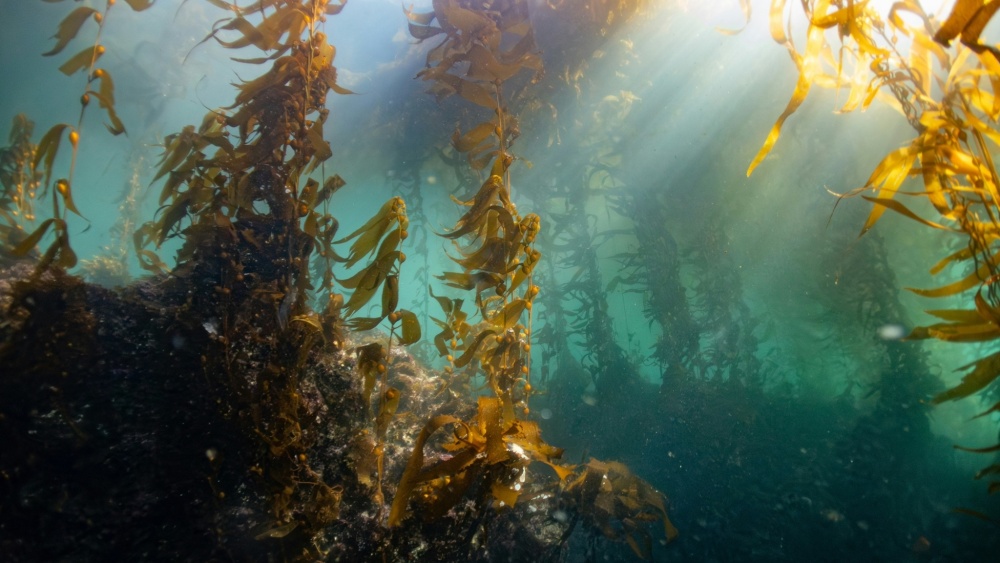
Giant Kelp, photo by Erick Morales Oyola
Giant Kelp
Macrocystis pyrifera
Laminariaceae family
This green/yellow coloured kelp is the tallest seaweed on eart, and can reach up to 45 - 60 metres! Each leaf is paired with a gas-filled bulb that helps it float up towards the sunlight.
45 - 60 metres tall
The Giant Kelp has wrinkled, lance-shaped blades with toothed edges, and a yellow, green and brownish colour.
Giant Kelp can provide a bed for sea otters, who wrap themselves in the fronds to sleep. This helps the otter from drifting away when they're sleeping.
Rocky reefs along the coastline in cool, clear, nutrient-rich water, usually 8 - 30 m deep. They used to cover a large part of Tasmania's East Coast, but in the past decades more than 95% of the Giant Kelp Forests in Tasmania have dissapeared.
It reproduces by spores, which are released in huge numbers. Release can happen through much of the year, with seasonal peaks.
Giant Kelp can be found in the Northeastern Pacific Ocean, from Baja California north along the western coast of the United States and Canada to southeast Alaska. In the Southern Oceans it can be found along the temperate coasts of South America, South Africa, Australia, and New Zealand.
Warming oceans, marine heatwaves, overgrazing by long-spined sea urchins, pollution and sedimentation.
Frequently asked questions about the Giant Kelp
Where can I see the Giant Kelp in Tasmania?
Giant Kelp can be found in the Northeastern Pacific Ocean, from Baja California north along the western coast of the United States and Canada to southeast Alaska. In the Southern Oceans it can be found along the temperate coasts of South America, South Africa, Australia, and New…
Is the Giant Kelp endangered?
What does the Giant Kelp look like?
The Giant Kelp has wrinkled, lance-shaped blades with toothed edges, and a yellow, green and brownish colour.
Where does the Giant Kelp live?
Rocky reefs along the coastline in cool, clear, nutrient-rich water, usually 8 - 30 m deep. They used to cover a large part of Tasmania's East Coast, but in the past decades more than 95% of the Giant Kelp Forests in Tasmania have dissapeared.
What threats does the Giant Kelp face?
Warming oceans, marine heatwaves, overgrazing by long-spined sea urchins, pollution and sedimentation.
How does the Giant Kelp breed and reproduce?
It reproduces by spores, which are released in huge numbers. Release can happen through much of the year, with seasonal peaks.
You might like...
Big-bellied Seahorse
The big-bellied seahorse (Hippocampus abdominalis) is one of three seahorse species found in Tasmanian waters. Reaching up to 35 cm in height, they are one of the worlds largest seahorses, with a big round belly as their distinctive feature.
Tasmanian giant freshwater crayfish (Astacopsis gouldi)
The Tasmanian giant freshwater crayfish is the largest freshwater invertebrate in the world. Photo: Tilde Bergstrom
Polar Bear
Polar bears are the world’s largest land carnivores and apex predators, inhabiting the Arctic sea ice. Photo: Hans-Jurgen Mager
Little Penguin
This little penguin, also known as the fairy penguin, weigh just under one kilogram. Adorably awkward on land, but a skilled predator in the sea, this cute little creature can be found in New Zealand and the southern coast of Australia. Image: Dr Eric Woehler
Newsletter
Sign up to keep in touch with articles, updates, events or news from Kuno, your platform for nature