
Three Brothers Hills: history, forest and a place valued by local people
Coast to Cradle Wild Country
A name from the past
The hills were named by surveyor Henry Hellyer, who recorded them on his 1828 survey map. Exactly which “three brothers” Hellyer had in mind has been lost to history, leaving a little mystery behind the name.
His map also gives us a fascinating glimpse into what this landscape looked like almost 200 years ago. Much of the deep red basalt country that is now covered by fertile farmland and crops was once described simply as “Lofty Forested Hills”.

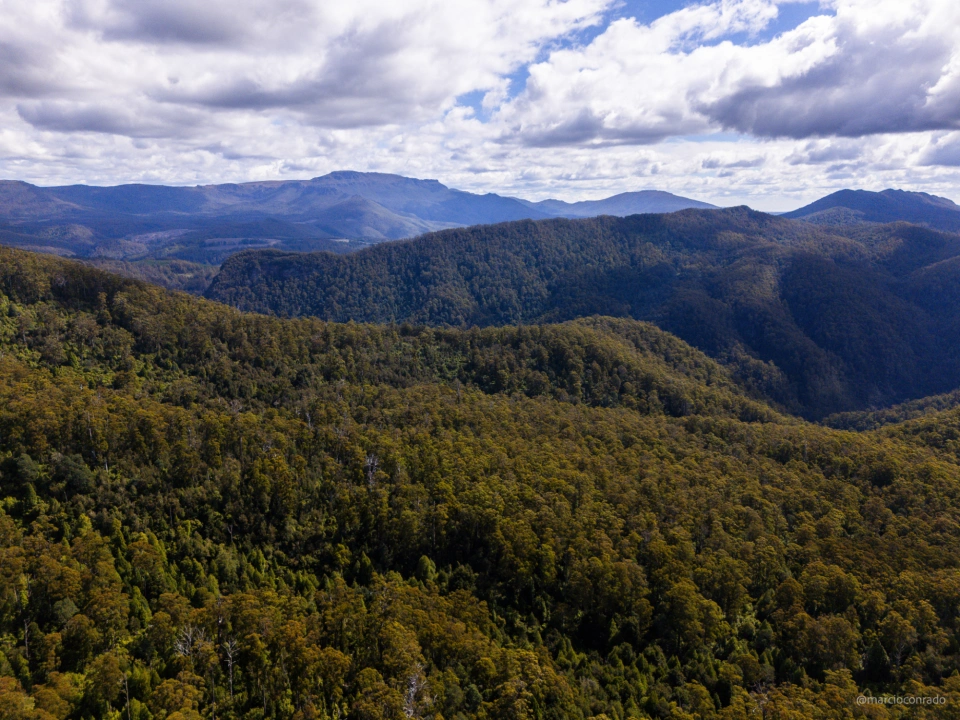
Giants of the forest
Over time, much of the original forest was cleared for agriculture. The steep and rocky terrain of the Three Brothers Hills, however, made it less suitable for farming, allowing some of these magnificent forests to survive.
Today, you can still see some of these forest giants on a short walk through the hills. The walk ends at a truly impressive tree, measuring around 3.5 metres wide at chest height.
This remarkable tree has the First Nations name koekunyer, meaning “come here, come close.” It is a fitting name for a tree that invites us to stop, look up and appreciate these ancient forests.
To explore the story of the forest giants further, visit Giants of the Leven.

A place valued by the community
The Three Brothers Hills have long been valued by local people. Community support for protecting the area began in 2003, when the Canyon to Bluff Working Group proposed that the Three Brothers Hills become a nature reserve.
That vision was later supported through the Tasmanian Forest Agreement 2012, and the forestry industry were paid compensation for protecting the area, altough this protection is yet to be formalised.
In 2021, support from the community, Central Coast Council and the Tasmania Parks and Wildlife Service helped establish the Leven Canyon / Loyetea Peak Scenic Protection Area, which includes the Three Brothers Hills.

Looking to the future
The Three Brothers Hills are a place where history, geology, old-growth forest and community connection come together.
While the area has received some protection throughout the years, the proposed nature reserve still needs to be formally gazetted. Now is our chance to come together and develop a shared vision for how this special place can be cared for into the future.
Do you want to have your say? Be a part of the Coast to Cradle Wild Country Community Vision: https://kuno.earth/articles/community-survey-coast-to-cradle
Kuno
A name from the past
The hills were named by surveyor Henry Hellyer, who recorded them on his 1828 survey map. Exactly which “three brothers” Hellyer had in mind has been lost to history, leaving a little mystery behind the name.
His map also gives us a fascinating glimpse into what this landscape looked like almost 200 years ago. Much of the deep red basalt country that is now covered by fertile farmland and crops was once described simply as “Lofty Forested Hills”.
Giants of the forest
Over time, much of the original forest was cleared for agriculture. The steep and rocky terrain of the Three Brothers Hills, however, made it less suitable for farming, allowing some of these magnificent forests to survive.
Today, you can still see some of these forest giants on a short walk through the hills. The walk ends at a truly impressive tree, measuring around 3.5 metres wide at chest height.
This remarkable tree has the First Nations name koekunyer, meaning “come here, come close.” It is a fitting name for a tree that invites us to stop, look up and appreciate these ancient forests.
To explore the story of the forest giants further, visit Giants of the Leven.
A place valued by the community
The Three Brothers Hills have long been valued by local people. Community support for protecting the area began in 2003, when the Canyon to Bluff Working Group proposed that the Three Brothers Hills become a nature reserve.
That vision was later supported through the Tasmanian Forest Agreement 2012, and the forestry industry were paid compensation for protecting the area, altough this protection is yet to be formalised.
In 2021, support from the community, Central Coast Council and the Tasmania Parks and Wildlife Service helped establish the Leven Canyon / Loyetea Peak Scenic Protection Area, which includes the Three Brothers Hills.
Looking to the future
The Three Brothers Hills are a place where history, geology, old-growth forest and community connection come together.
While the area has received some protection throughout the years, the proposed nature reserve still needs to be formally gazetted. Now is our chance to come together and develop a shared vision for how this special place can be cared for into the future.
Do you want to have your say? Be a part of the Coast to Cradle Wild Country Community Vision: https://kuno.earth/articles/community-survey-coast-to-cradle
You might like...
Coast to Cradle Wild Country Map
Coast to Cradle Wild Country: Community Survey
Coast to Cradle Wild Country: The Film
Join our Coast to Cradle Open Days and Community Workshops!
Newsletter
Sign up to keep in touch with articles, updates, events or news from Kuno, your platform for nature