
Giants of the Leven
Coast to Cradle Wild Country
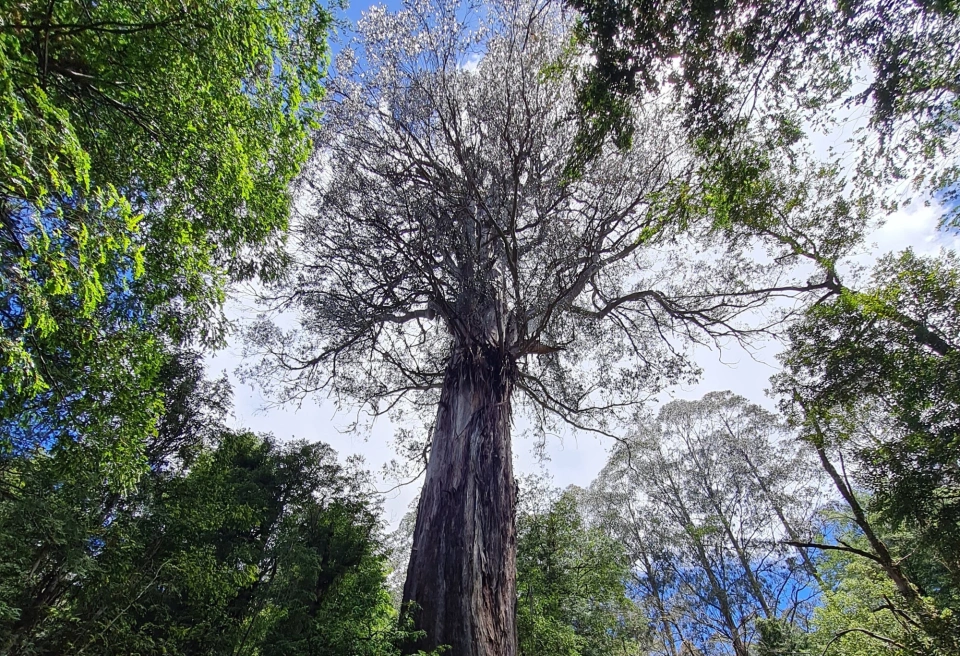
This forest is currently classified as Future Potential Production Forest (FPPF), meaning that it has no formal reserve status and remains unprotected. Protect Our North West Forests are working hard to highlight the incredible wonders of this forest, and so far the group has documented 49 trees between 2.5-4m in diameter, and 2 trees over 4m in diameter which are classified as 'giants'.
If you want to visit these extraordinary trees there is a walking trail named Giants of the Leven, which can now be found on AllTrails.

Giants of the Leven is a 4,6km walk of moderate difficulty.
It starts out in a plantation, before it enters the lush beauty of native forest. The shift is immediate and striking: from uniform rows of gums with little biodiversity to a fairytale-like forest filled with ferns, mosses, and abundant diversity.

Along the trail, two short offshoots lead to Big Tree 1 and Big Tree 2, both immense, majestic old trees that give a sense of the forest’s true scale and age.


At the end of the walk stands the giant itself, Koekunyer.
Approximately 300 years old and 11,2m in circumference, with a massive hollow tall enough to walk into, Koekunyer will leave no one untouched.

Protect our North West forests writes:
Koekunyer (koe-kun-yer), meaning “come here / come close”, comes from the old historical records of Tasmanian Aboriginal language collected mainly by George Augustus Robinson in the 1820s–30s, when he was traveling and recording phrases spoken by Aboriginal people. This was recorded in the Middlesex plains area. Koekunyer rises above the surrounding forests, calling, inviting visitors to this place to “stand close”, “listen deeply”, respect Country, reminding us we are not separate.


------------------------------------------------------------------------
A working group is bringing together a community-led vision for the Coast to Cradle Wild Country, and are inviting the community to drive and shape this vision so it captures their dreams for the future of this very special place.
Have your say by filling out the community survey: https://kuno.earth/articles/community-survey-coast-to-cradle
Tilde Bergström
Conservation Stories Editor
This forest is currently classified as Future Potential Production Forest (FPPF), meaning that it has no formal reserve status and remains unprotected. Protect Our North West Forests are working hard to highlight the incredible wonders of this forest, and so far the group has documented 49 trees between 2.5-4m in diameter, and 2 trees over 4m in diameter which are classified as 'giants'.
If you want to visit these extraordinary trees there is a walking trail named Giants of the Leven, which can now be found on AllTrails.
Giants of the Leven is a 4,6km walk of moderate difficulty.
It starts out in a plantation, before it enters the lush beauty of native forest. The shift is immediate and striking: from uniform rows of gums with little biodiversity to a fairytale-like forest filled with ferns, mosses, and abundant diversity.
Along the trail, two short offshoots lead to Big Tree 1 and Big Tree 2, both immense, majestic old trees that give a sense of the forest’s true scale and age.
At the end of the walk stands the giant itself, Koekunyer.
Approximately 300 years old and 11,2m in circumference, with a massive hollow tall enough to walk into, Koekunyer will leave no one untouched.
Protect our North West forests writes:
Koekunyer (koe-kun-yer), meaning “come here / come close”, comes from the old historical records of Tasmanian Aboriginal language collected mainly by George Augustus Robinson in the 1820s–30s, when he was traveling and recording phrases spoken by Aboriginal people. This was recorded in the Middlesex plains area. Koekunyer rises above the surrounding forests, calling, inviting visitors to this place to “stand close”, “listen deeply”, respect Country, reminding us we are not separate.
------------------------------------------------------------------------
A working group is bringing together a community-led vision for the Coast to Cradle Wild Country, and are inviting the community to drive and shape this vision so it captures their dreams for the future of this very special place.
Have your say by filling out the community survey: https://kuno.earth/articles/community-survey-coast-to-cradle
You might like...

Forests critical for Climate and Biodiversity Protection

Guardians of the Forest
Ancient beauty in Victoria's central highlands
Make It Happen! A Great Forest National Park Short Film
Newsletter
Sign up to keep in touch with articles, updates, events or news from Kuno, your platform for nature