
Eastern Quoll
The Eastern Quoll: The Fight Against Ferals
The Eastern Quoll is black or brown with white spots. It breeds from May to August giving birth to around five to eight young ones.
This endangered species was once common on mainland Australia, but were hunted to extinction by feral cats. It’s now only found wild in Tasmania. Cats were introduced to Australia by early settlers and have since spread across the landscape, hunting native wildlife and causing biodiversity decline. The threat of feral cats is an issue in Tasmania too, together with habitat loss and diseases.

Threatened
Eastern Quoll
Dasyurus viverrinus
Dasyurids
They are a sleek small animal with clawed feet placed just below its brown or black spotted body. It has a long tail with short hair.
For most species the males are larger than females, and the same is true for the Eastern Quoll. Males can be between 53-66 cm while females are 48-58 cm.
Their white spots that run on their body, although not on their tail.
This species used to live on mainland Australia, but due to new introduced species, loss of habitat and disease they are now extinct on the mainland and only exist in Tasmania. The last sighting of the Eastern Quoll on mainland Australia was in 1963.
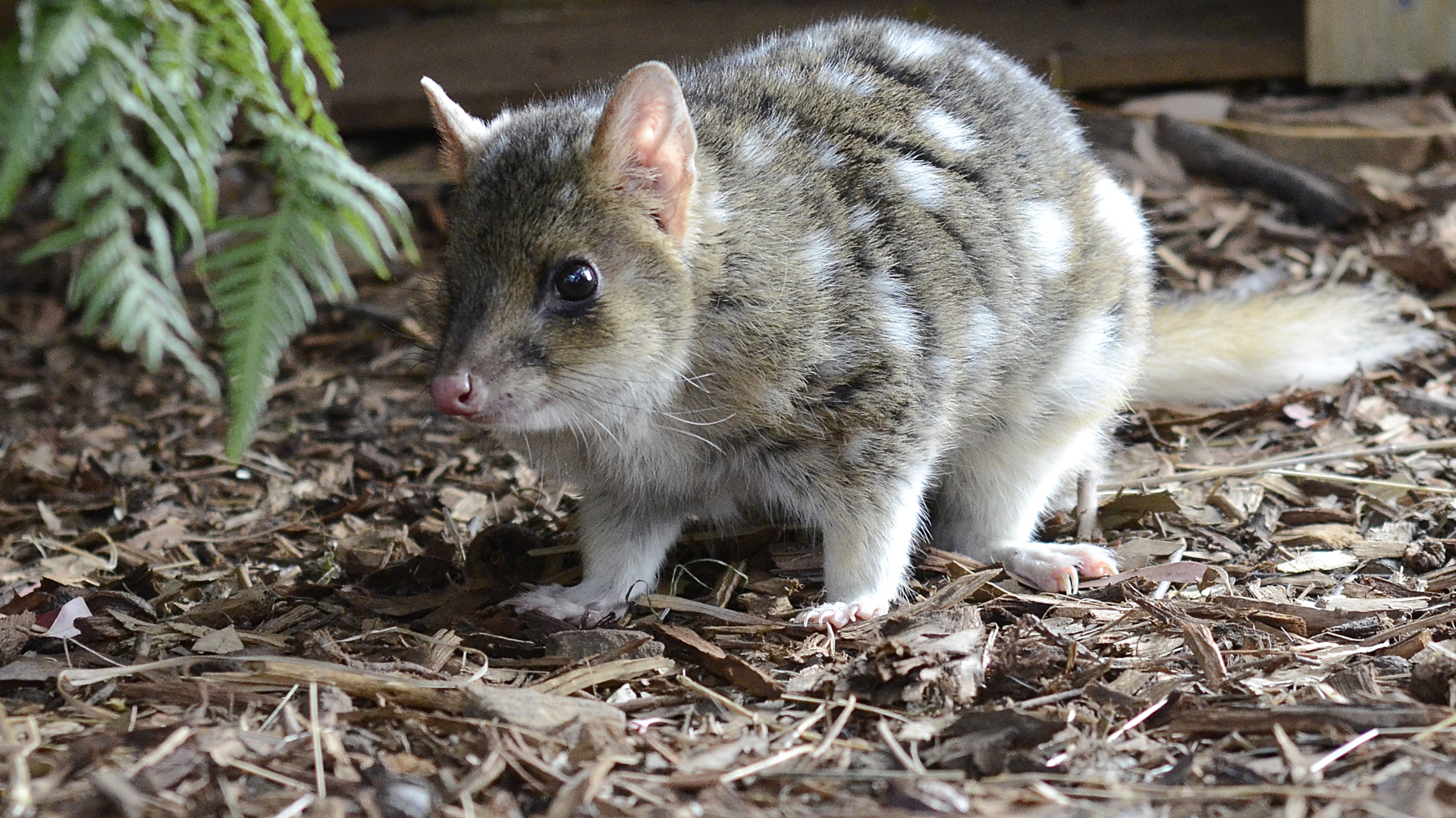
Image by Dan Broun
They like heathlands, shrublands, and sclerophyll forests.
They are opportunistic carnivores, meaning they’ll eat a wide range of animal foods depending on what’s available. They like beetles, corbie shrubs, fruit and will also scavenge on dead animals.
Eastern Quolls breed from May to August. The females usually give birth to five to eight pups per litter. Being marsupials, the young quolls spend the first part of their lives in a pouch.
They can be found all over Tasmania, including Bruny Island which is a stronghold for them.
Endangered
Predation from feral cats, competition from feral cats, habitat loss and disease.
They communicate in growls, hisses, and screams.
They can be seen in forests after dusk or at night.
Active management of ferrel cats and help with getting their numbers up. This is in Threatened Species Action Plan 2022-2032
Frequently asked questions about the Eastern Quoll
What does the Eastern Quoll eat?
They are opportunistic carnivores, meaning they’ll eat a wide range of animal foods depending on what’s available. They like beetles, corbie shrubs, fruit and will also scavenge on dead animals.
Where can I see the Eastern Quoll in Tasmania?
They can be seen in forests after dusk or at night.
Is the Eastern Quoll endangered?
Endangered
What does the Eastern Quoll look like?
Their white spots that run on their body, although not on their tail.
Where does the Eastern Quoll live?
They like heathlands, shrublands, and sclerophyll forests.
What threats does the Eastern Quoll face?
Predation from feral cats, competition from feral cats, habitat loss and disease.
How does the Eastern Quoll breed and reproduce?
Eastern Quolls breed from May to August. The females usually give birth to five to eight pups per litter. Being marsupials, the young quolls spend the first part of their lives in a pouch.
You might like...

Bruny Island: eastern quoll stronghold

Ecology of the Neck
Swift Parrot
The critically endangered Swift Parrot is a species of broad-tailed parrot only found in south-eastern Australia. Image: Rob Blakers
Newsletter
Sign up to keep in touch with articles, updates, events or news from Kuno, your platform for nature